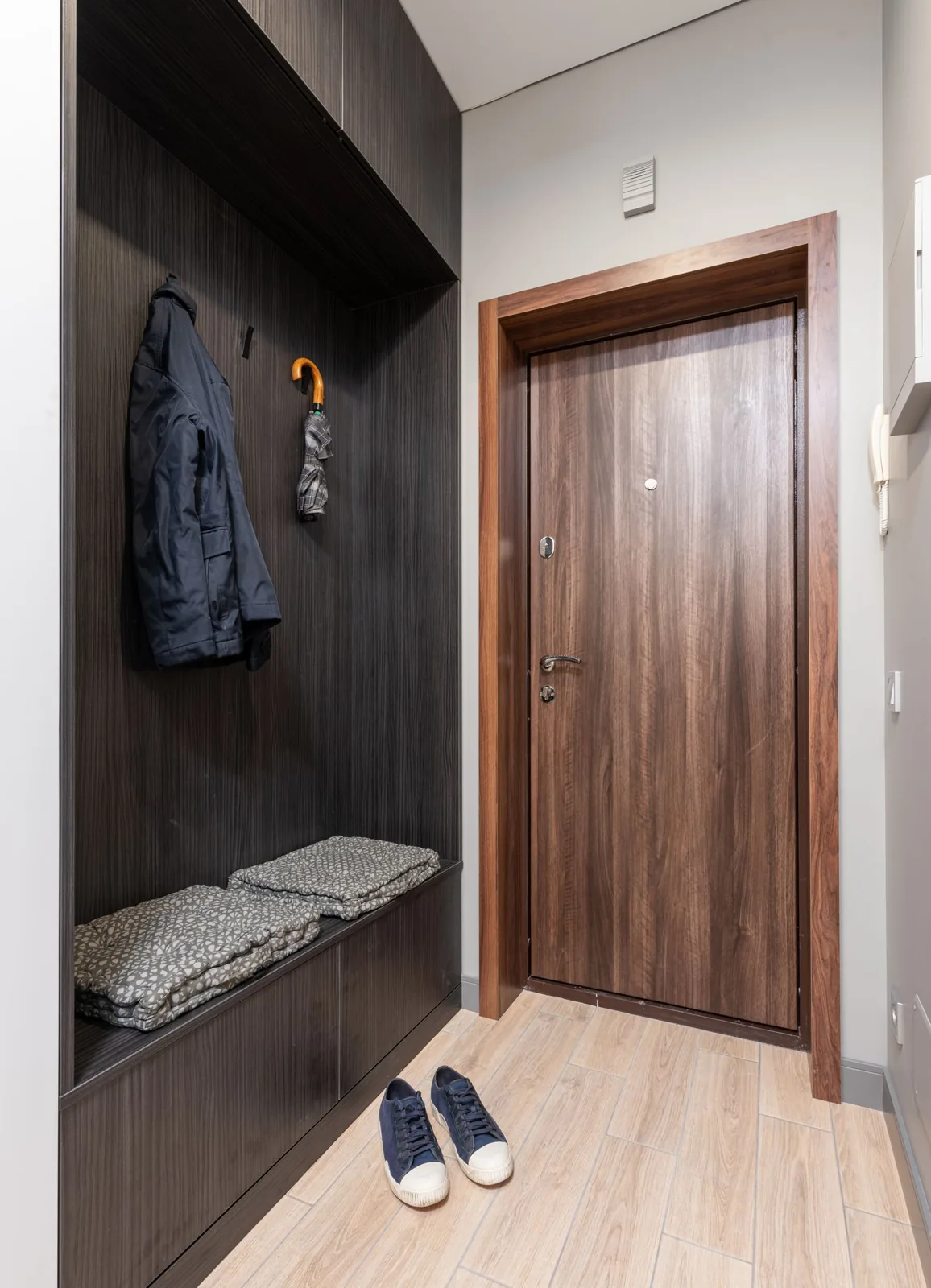
An evening reset is a small handoff to tomorrow, not a second shift of housework. Choose a few useful actions, give them a limit, and stop. Ten minutes is a suggested boundary to adapt, not a promise that every room can be restored in that time.
Choose tomorrow's first point of friction
Think about the first part of the next morning at home. Perhaps you need a clear place for breakfast, a bag ready to leave, or a chair that is not covered in clothes. Choose one problem whose improvement would be directly useful. Avoid beginning with a scan of everything you dislike about the house; that turns a small reset into an unlimited project.
Name the outcome in observable terms. The table has enough space for breakfast, the things you need are in the agreed destination, or the floor route is clear. These are practical conditions you can assess. This guide makes no promise about sleep, mood, productivity, or stress.
Set a limit that includes putting things away
Choose a short time boundary and a point in the evening that is realistic for you. Ten minutes may suit one person; a much shorter version may suit another. Include the time needed to return any supplies you use. A timer should prevent the task from expanding, rather than become pressure to hurry through a large amount of work.
Apartment Therapy's routine guidance suggests making manageable changes instead of adding an overwhelming new step. Apply that idea by starting with one useful area. Do not make the routine dependent on cleaning every room, folding all laundry, or making several household decisions. If an urgent safety issue or necessary care task arises, handle it appropriately rather than treating the timer as a reason to leave a problem unresolved.
Use a short route through one area
Choose a simple sequence. You might return objects that already have homes, clear the needed surface, and put tomorrow's ordinary essentials in place. Keep the sequence close enough that you are not crossing the home repeatedly. Avoid carrying an unstable stack of objects simply to complete the routine in fewer trips.
A temporary container can help gather suitable loose items, but it needs a destination and a plan to be emptied. It should not become a nightly transfer from visible surfaces to a forgotten box. IKEA's clothes organization guidance acknowledges intermediate storage stages; the useful distinction is that temporary means there is a defined next action. Keep damp, fragile, sensitive, sharp, or otherwise unsuitable items out of a mixed collection.
Separate returning from deciding
Returning an object to an established place is a different task from deciding whether to keep it. The evening reset is usually better suited to the first. If an unfamiliar paper, repair problem, or ownership decision appears, put it in an appropriate defined review location and record the next action. Do not let the reset become an unplanned session sorting years of belongings.
This separation is not permission to defer every decision indefinitely. Choose a realistic review point for items that need attention, and keep that holding area bounded. If the same objects return to the surface each evening, their destinations may be unsuitable. Make a note for a separate organizing session rather than repeatedly tidying them into a place no one wants to use.
Agree on shared participation and a fallback
If more than one person uses the area, decide together which small outcome matters and who is taking responsibility. Do not silently organize someone else's private belongings or assume everyone has the same energy, availability, or standards. A shared room can have an agreed minimum without requiring a complete household routine redesign.
Choose a reduced version for evenings when the full plan is impractical. That might be a single cleared route or returning one essential group. It is also reasonable to skip an optional routine when circumstances demand it. Avoid defining a missed evening as failure or using a checklist to monitor another person. The routine is a tool for the household, not a measure of anyone's character.
Stop, then evaluate the next morning
At the end of the chosen time, return any materials and stop the optional task. Avoid adding one more drawer simply because the room is looking better. The next morning, check whether your chosen outcome was useful. A clear breakfast surface may help; resetting decorative cushions may make little difference to your actual morning. Keep what earns its place.
After several ordinary uses, remove steps that add effort without a useful result. If the reset regularly grows longer, narrow its scope or improve the underlying storage handoff. There is no need to keep increasing the number of tasks. A sustainable version may remain very small.
Tomorrow's breakfast place and the unfinished paperwork
Choose the place needed for breakfast and identify where today's work papers may wait. Return the ordinary tableware appropriately, move the papers to that agreed location and leave any unresolved document clearly assigned to its owner. Stop at the chosen boundary rather than starting a full filing project. If the papers have no destination, record that as tomorrow's separate decision; hiding them on a chair would only move the problem. Ten minutes remains an adaptable limit, not a guarantee. The useful check next morning is whether the intended place is available without another round of searching.