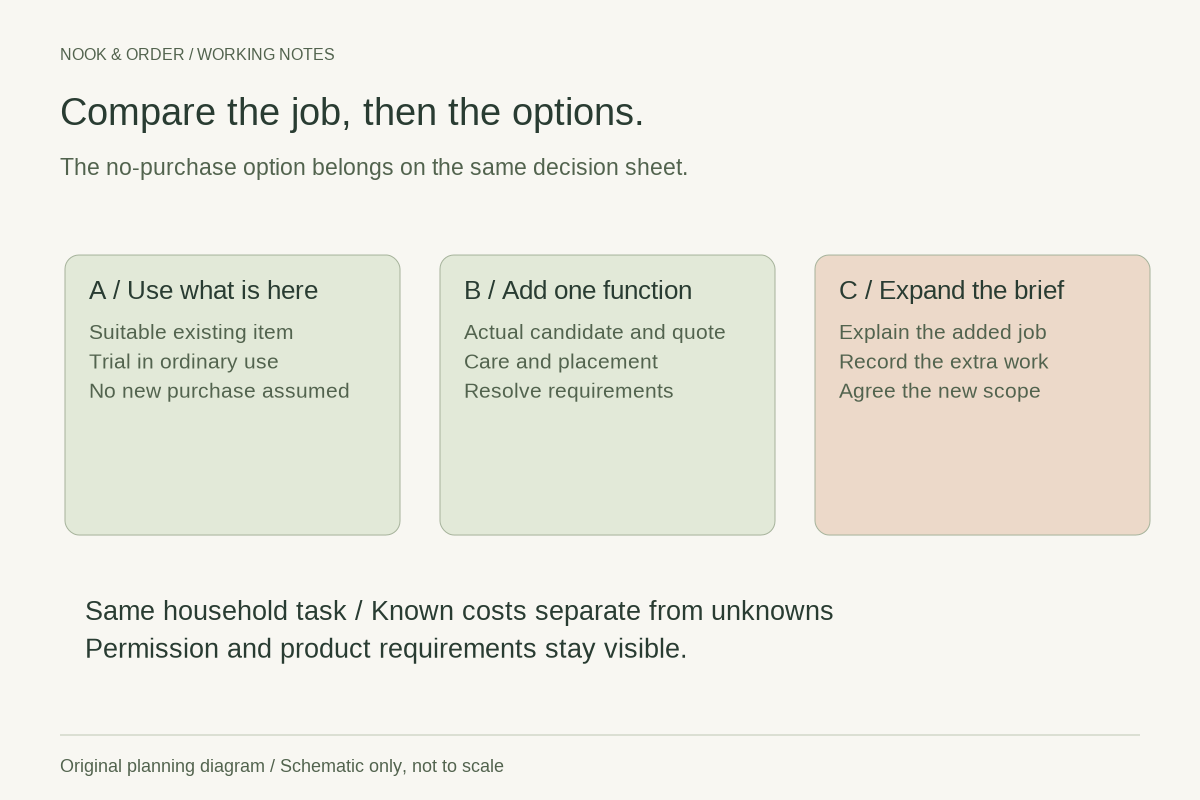
A room refresh can begin with one problem and expand into a collection of purchases whose jobs overlap. A better comparison asks what each option would do here, what it would cost in known terms and what work it would introduce. This guide develops a practical option sheet for a bounded rental-room decision. It is not a financial forecast, a promise of savings or a method for estimating the resale value of furniture.
Define the useful result and the spending boundary
Write the activity the refresh should improve and what must remain in the room. For example, a reading position needs suitable light and a convenient place for the book, while the sofa and walls stay. Separate that functional result from appearance preferences. This allows a useful modest change to count as finished instead of becoming an unfinished full-room makeover.
Choose a spending boundary you are comfortable with, using your actual circumstances. Record already committed expenses separately from possible ones. Do not borrow a universal percentage or claim that a room should cost a particular amount to refresh. If an option's unknown costs could change the decision, leave room for them to be clarified before treating the comparison as settled.
Include an appropriate no-purchase option
List a suitable rearrangement or reuse of an existing object where one could serve the task. EPA waste guidance includes borrowing, sharing and repair among alternatives to new acquisition. NYSDEC also describes reuse and repair. Those sources support considering options before buying; they do not establish that any old item can safely serve a new purpose.
Describe the actual check for your no-purchase option. Can the existing lamp be positioned according to its requirements? Does the existing seat allow the relevant activity? Does moving a table create a new obstruction elsewhere? An option is useful only if it serves the task under the room's real constraints. Record a failed trial rather than declaring rearrangement automatically successful or free of effort.
Keep quoted amounts separate from unknowns
For each purchase option, record the item price and any relevant actual quote for delivery, assembly, fitting or other services. Note the date and source. Use unconfirmed where a charge is not known instead of silently entering zero. Check what the quote includes and whether it refers to the exact product and location under discussion.
Keep optional additions separate. A lamp decision should not quietly acquire a new chair, rug and matching accessories because they look attractive together. If an addition serves another household problem, give it its own brief or explicitly expand this one with agreement. The worksheet helps reveal the change in scope; it does not decide whether the household can afford the expanded project.
Describe the ongoing work in ordinary actions
Record what ownership would require: a care method, appropriate storage, moving help or keeping instructions and original parts. Avoid estimating a lifetime cost without evidence. A useful note can simply say that a large textile's permitted care exceeds the facilities currently available, or that a candidate needs a suitable installation arrangement before use.
Compare these actions against the actual household routine. Something portable may still be awkward to handle, maintain or store between uses. Reusability in a later rental is a possibility, not a guarantee that the next home will have compatible dimensions. Keep future fit and resale assumptions visibly uncertain so they do not disguise a poor match for the current room.
Treat permission and installation as requirements
For a property change, clarify the actual permission process and retain the response. Keep the product's requirements alongside it. CPSC guidance emphasizes following manufacturer instructions to secure furniture and televisions. A rental constraint cannot be resolved by ignoring required anchoring, and the word portable does not mean a product has no installation needs.
If a candidate has an unresolved requirement, mark it blocked rather than balancing it against an appealing color or lower price. Seek the appropriate answer or compare a different suitable option. This guide does not interpret tenancy agreements or provide an installation method. A comparison sheet is valuable because it exposes a conflict before the household commits money and space to it.
A hypothetical reading corner with three options
Suppose the brief is to improve evening reading in a room where the sofa remains. Option A moves an existing suitable lamp and seat arrangement. Option B adds an appropriate portable lamp. Option C replaces the chair and adds a lamp. The household tests A under the actual evening conditions and records what function, if any, is still missing.
If A serves the task appropriately, the comparison can finish there. If it does not, B can be evaluated with its actual price, placement and product requirements. C needs a clear reason for the extra chair rather than inheriting approval from the lighting problem. This is a hypothetical decision sequence, not a reported room test or a claim that one arrangement works for every reader.
Finish with the smallest justified commitment
Choose the suitable option that answers the brief on the terms you have actually confirmed. Record why it was selected, what would make you reconsider and which details remain unresolved. If the result is to wait for a quote or permission, name that next action. Waiting for information is a legitimate decision rather than a failure to complete the worksheet.
After the change, repeat the activity named at the beginning and check the room's other routes. Keep the successful outcome distinct from a desire for more decoration. If another problem remains, write a new brief based on that observation. This gives future purchases a concrete job and lets a finished refresh stay finished until there is a reason to expand it.
PUT THIS GUIDE TO WORK
Compare three ways to do one job
Include a suitable existing-item option. Record known amounts and unknown requirements separately.
| Check | Record or try | If it does not work |
|---|---|---|
| Function | One activity, fixed features and a visible finish | Avoid letting accessories silently expand the brief. |
| Known costs | Actual price and relevant quoted services, with dates | An unknown charge is not zero. |
| Work and requirements | Care, installation, permission and eventual handling | Block unresolved requirements instead of scoring them away. |
Finish when: A suitable option answers the brief, with the choice and remaining questions recorded.
Pause when: The decision relies on unconfirmed costs, ignored product requirements or assumed permission.