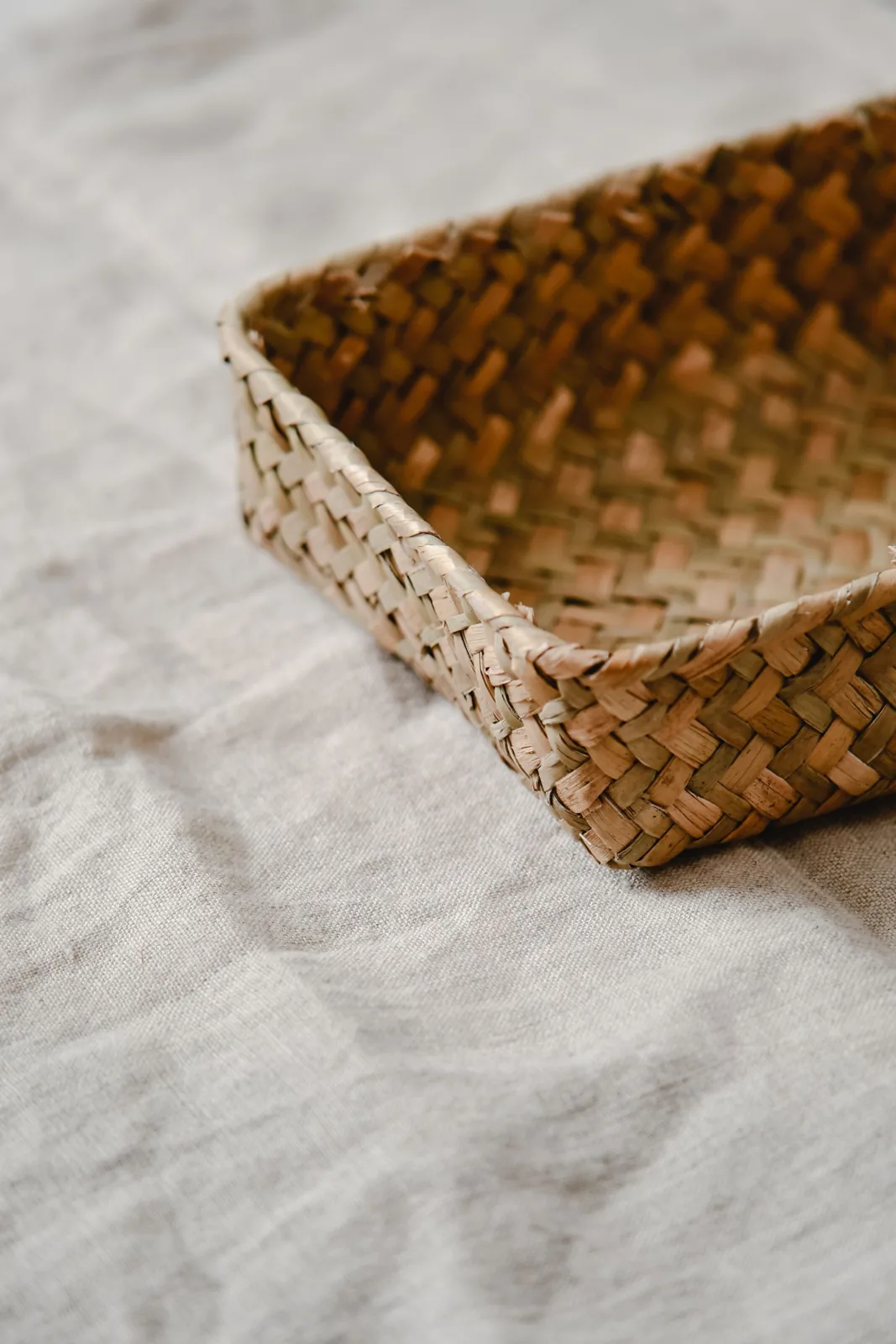
A woven basket may be made from plant fibers, paper, synthetic material, or a mixture with a coating or liner. Identify what you can before choosing care. An apparently sturdy weave can contain weak points, and ordinary dust removal is a different decision from washing or repairing it.
Find the maker and examine the whole construction
Look for product details, care instructions, and the intended use. Inspect the weave, base, rim, handles, liner, and any decoration. A removable textile liner may have its own instructions, while a painted area may respond differently from the undyed fibers beside it. Keep those distinctions rather than assigning one care method to the word basket.
For an older or unidentified object, write down what is known and what is uncertain. Its value may be personal, cultural, or historical as well as practical. The Canadian Conservation Institute discusses baskets as collection objects, often with brittle plant materials. That context supports caution; it does not turn every modern household basket into a museum object or establish its exact material from a photograph.
For a lined basket, remove the liner only if the construction and instructions permit it. Keep its care record separate from the outer weave. A washable lining does not establish permission to immerse the basket, and an unlined replacement may change the suitability of its intended contents.
Check condition before loading or lifting
Look for loosened bindings, broken fibers, distorted areas, and weak connections. Do not test a questionable handle by filling the basket and lifting it. A basket used for decoration may no longer be suitable for carrying a laundry load, even if it once performed that job. Respect the maker's actual load and use requirements.
CCI identifies poor handling as a major source of damage in historic basketry and recommends supporting the base. Apply a cautious support approach to an uncertain object, using both hands where appropriate and avoiding strain on fragile rims or handles. If the object cannot be moved without stressing it, obtain suitable help. Do not assume a handle remains a reliable lifting point simply because it is still attached.
Keep loose dust separate from a cleaning treatment
For a current household product in sound condition, follow its specified routine care. If gentle dry dust removal is permitted, work carefully and stop when fibers or decoration move. A method suitable for a smooth synthetic container can catch on an intricate plant weave. Do not force a stiff tool through gaps to chase every particle.
Institutional conservation guidance describes controlled techniques for fragile basketry, but these require judgment and equipment. They are not an invitation to modify a vacuum cleaner or apply strong suction at home. Unknown powders, soot, mold, or possible infestation need an appropriate assessment. Avoid brushing such material around the room or treating a potentially serious condition as ordinary decorative dust.
Keep detached decorative parts associated with the basket until appropriate advice establishes what should happen next.
Do not make soaking the default
Plant materials can contain water-soluble compounds and dyes. CCI explains how wetting can produce tide lines, staining, or dye movement in basketry. A basket's natural appearance does not mean water is harmless, and an earlier successful wipe on another basket does not establish compatibility for this one.
Check exact care directions before using water, soap, oil, bleach, or a household spray. Do not add oil merely to make fibers look richer, or soak a misshapen basket in an attempt to restore its form. If a valued object needs treatment or repair, consult an appropriate conservator. This guide deliberately stops at identification and preventive handling rather than offering a universal wet-cleaning or reshaping method.
Leave space around the stored shape
Choose a destination where the basket can be supported without being squeezed against neighboring objects. Avoid wedging one fragile basket tightly inside another. Nesting may save shelf area but can put pressure on rims, decoration, and uneven surfaces; check whether the actual product is intended to nest before choosing that arrangement.
Consider light, nearby heat, water sources, and the stability of the environment, especially for plant materials and dyed decoration. Keep stored contents compatible with the basket's purpose and any liner. A basket is not automatically a protective enclosure for a delicate photograph or a suitable place for damp textiles. The container itself and the things inside it each need an appropriate storage decision.
Record a change instead of disguising it
If a fiber detaches from a valued basket, keep the piece associated with the object and note where it came from. Do not glue it back as an organizing shortcut. Repairs can change both the object and the options available to a conservator. Follow professional advice for fragile, significant, or culturally sensitive material.
A handle is not proof of carrying strength
For a basket holding household textiles, look at the base, rim, handle attachments and any lining before deciding how it will move. A decorative handle and a sound-looking weave do not establish a carrying capacity. If an attachment is loose, unload the basket appropriately and reconsider its use rather than disguising the weakness with a new liner. Keep the condition concern separate from a dusting task. A different suitable container may serve the moving load, while the basket awaits assessment. This choice preserves the distinction between organizing the contents and treating a damaged object.