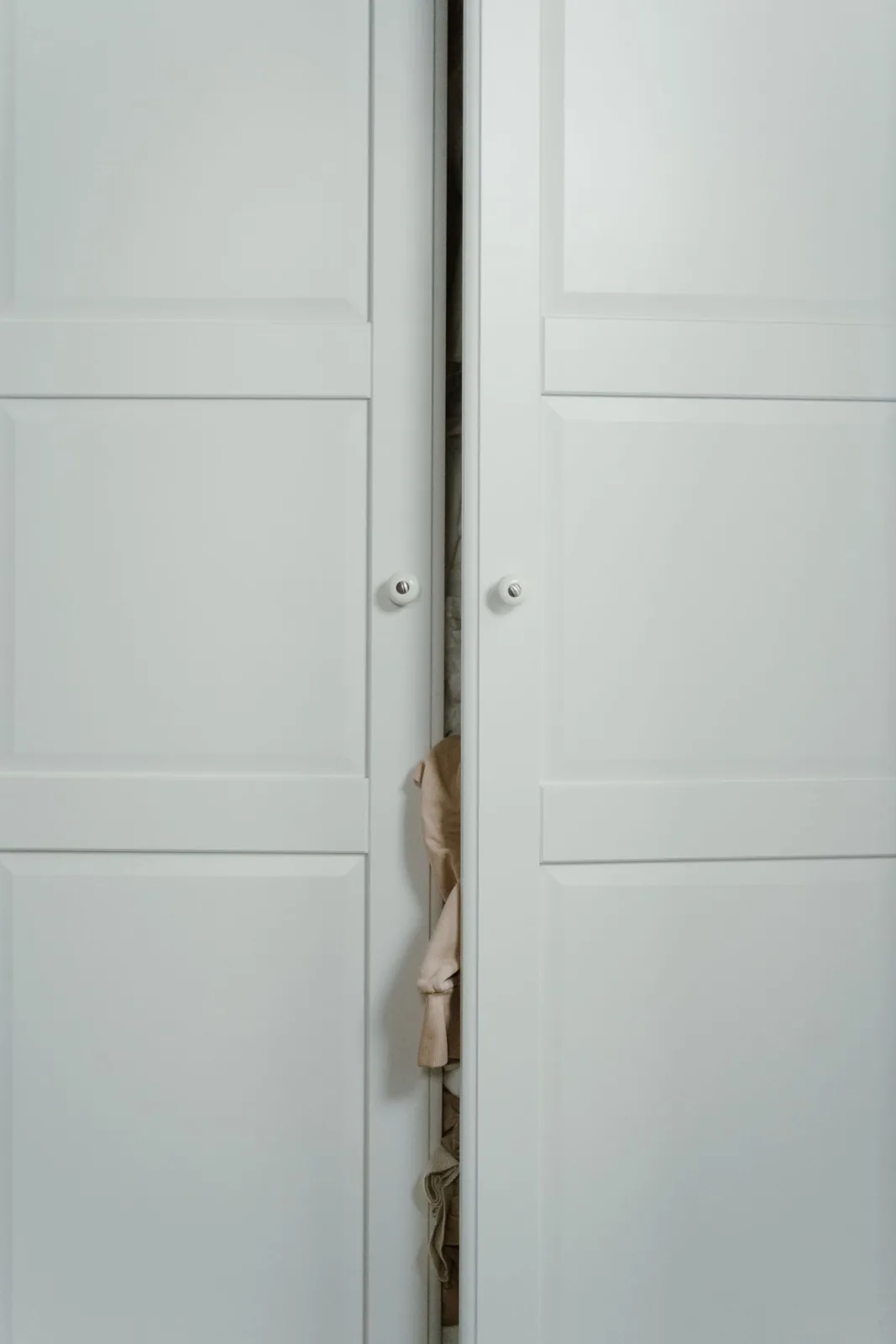
A cupboard can look spacious while half its contents are in use. It can also look full because one unrelated group occupies the easiest shelf. Before buying containers, audit one bounded storage area with the ordinary returning load in view. The result should tell you which constraint needs attention: the amount kept, the space assigned or the action required to return it. This is a household observation method, not a universal limit on possessions.
Choose a boundary that can be restored
Select one drawer, shelf or section of a wardrobe. Identify the people whose belongings it contains and agree what you may move. Do not empty several rooms to investigate one shelf. Place removed items on a suitable temporary surface, keep access routes clear and plan how the area will be put back before stopping.
Write down the task the area serves. “Keep the towels we actively use” is a clearer boundary than “store everything neatly.” Include what should not belong there, such as an unresolved repair bag. That distinction helps reveal an assignment problem without quietly authorizing you to discard someone else's possessions. Keep undecided items identifiable throughout the review.
Observe the load at its fullest ordinary stage
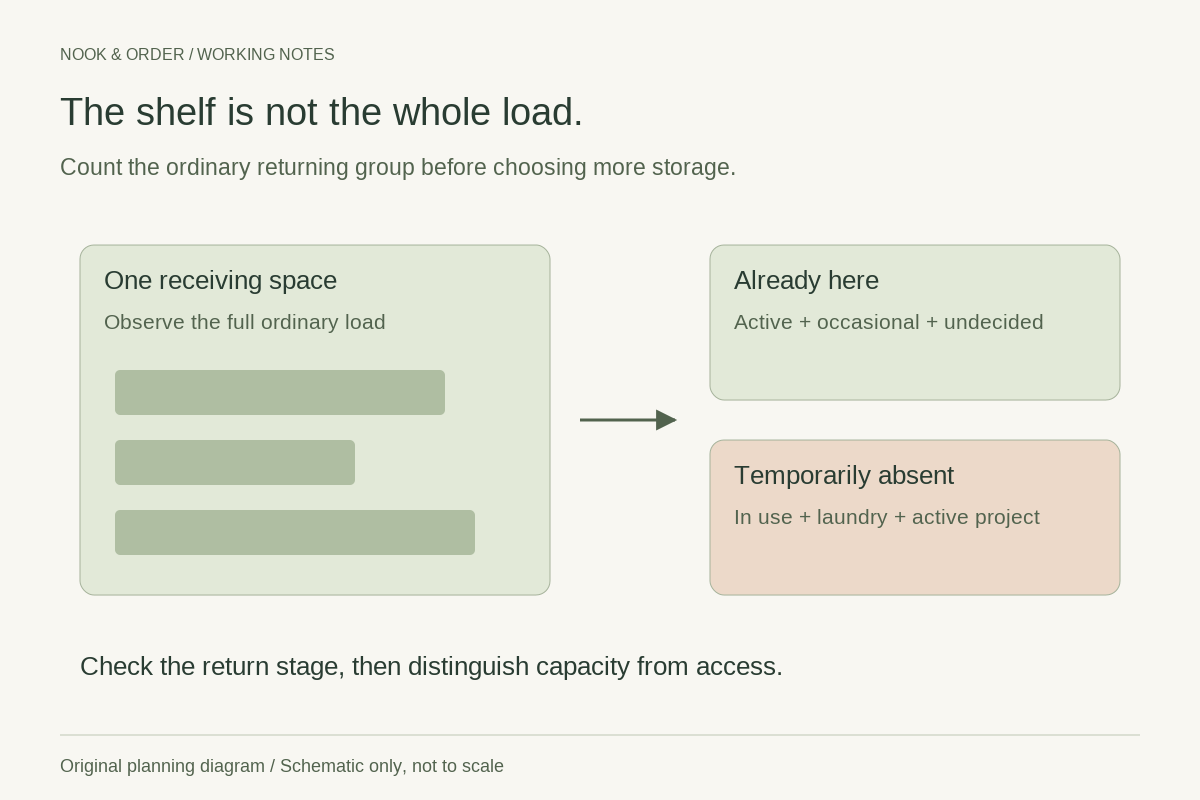
Look for what is temporarily absent. Clothes may be in the wash, bed linen may be in use, and hobby supplies may be spread across a project. List these groups before judging spare capacity. You do not have to collect unsafe or impractical loads for a demonstration; a clear record of the missing group is better than pretending the visible contents are complete.
For textiles, follow the actual care instructions and return suitable clean, dry items only when ready. The audit must not accelerate a drying process or compress an unsuitable object to make the arithmetic attractive. Note the point in the routine when this storage area normally receives the whole group. That is the state the arrangement needs to accommodate.
Give each group a reason for occupying this location
Separate active contents, occasional contents and items awaiting a decision. These are working descriptions, not rankings of personal importance. An occasional item may still need suitable protected storage. An item awaiting repair needs a next action and a responsible person rather than automatic removal from the household.
Ask whether each group needs this particular location. Frequently returned items may benefit from easier access, while an occasional group may have another appropriate destination. EPA guidance includes borrowing or sharing infrequently used items among ways to reduce new consumption. That supports considering alternatives to acquiring more belongings; it does not establish that a household must give up any specified quantity. Ownership decisions remain with the people involved.
Test the receiving space before choosing a container
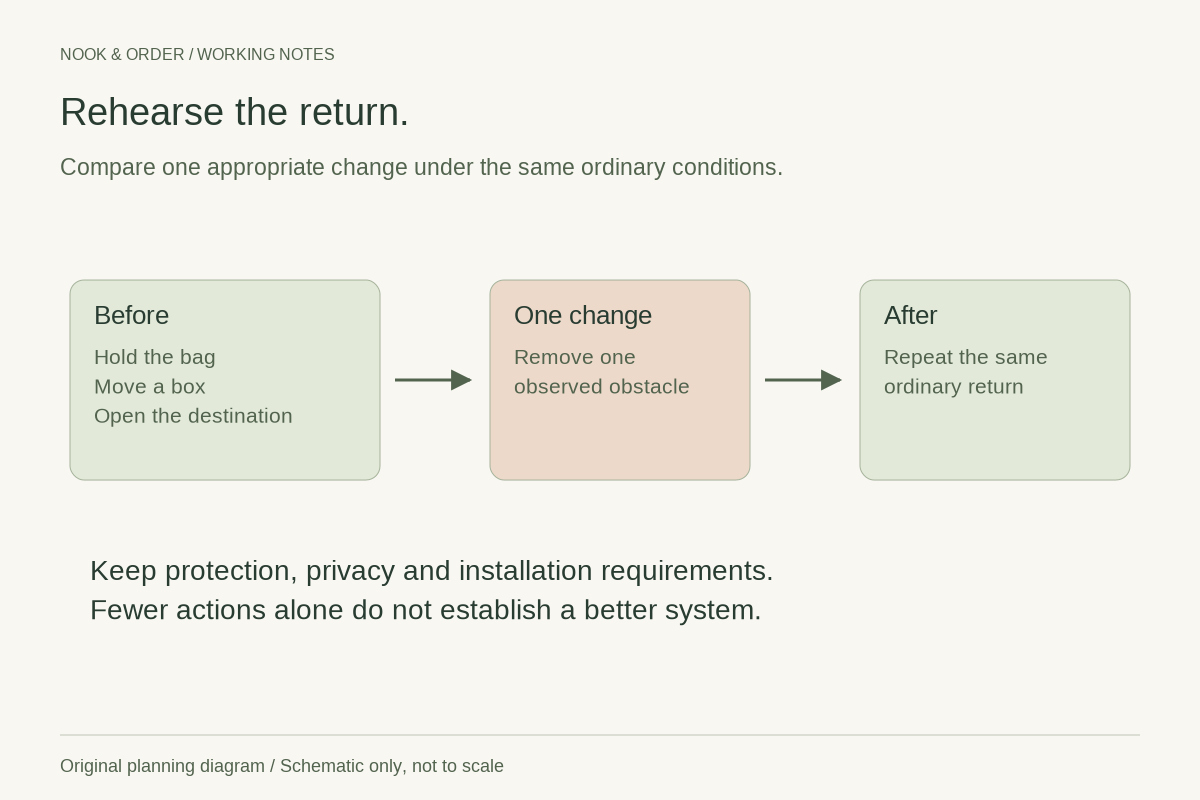
Bring the active group into a workable arrangement using suitable existing storage. Observe whether the destination supports the contents and allows the drawer or door to operate normally. Include handles, shelf fittings and the space needed to reach the group. A container's advertised volume does not describe all of those constraints.
If the contents fit but require lifting several unrelated stacks, the problem may be access rather than total capacity. Record that separately. A larger container could preserve the same awkward action. If the complete active group still has no suitable space, name the shortfall honestly and compare appropriate changes to contents or storage. Do not force the door closed as evidence that the system works.
Check the cost of adding another storage piece
Additional storage occupies floor or wall space and introduces its own installation and return actions. Sketch that working footprint before deciding it solves the original shortfall. The CPSC's furniture guidance calls for following the manufacturer's securing instructions. A tall storage unit is not a solution if its required installation cannot be arranged.
Also identify what would move into the new piece and what would leave the old area. Without that transfer plan, a second unit can become a second mixed destination. Keep proposed purchases separate from the observation record. First establish the job and relevant requirements; then compare products that could perform it. This prevents a container choice from defining the household's needs backward.
A hypothetical linen shelf with a missing return load
Suppose a shelf holds two folded sets while another set is on a bed and a fourth is being laundered. The shelf looks open during the tidy-up. Once all four are suitably ready for storage, retrieving a complete set requires disturbing the rest. The initial photograph recorded a partial load, not a successful full arrangement.
One possible trial is to organize the active sets so each remains identifiable and can be returned independently, provided the shelf and textiles support that approach. Another is to assign an appropriate separate destination to an occasional set with its owner's agreement. The example does not prescribe a number of sets to own. It shows why the return stage changes the diagnosis.
Repeat the observation after ordinary use
Keep a short note of the boundary, returning groups and chosen change. After the relevant laundry cycle, shopping trip or hobby session, check the same destination again. Record whether the active contents fit and whether returning them still requires moving an unrelated group. A clean photograph is optional; the repeatable action is the evidence you need.
If capacity works but the return still fails, move to the one-motion return test. If contents genuinely exceed the appropriate storage, discuss that specific constraint with the owners before expanding the project. The audit finishes with a clear next decision, even when that decision is to obtain information or leave a proposed purchase unmade.
PUT THIS GUIDE TO WORK
Audit one receiving space
Count the ordinary returning group, including contents temporarily in use elsewhere.
| Check | Record or try | If it does not work |
|---|---|---|
| Boundary | One shelf, drawer or suitable section | Restore it before expanding the project. |
| Returning load | Active contents plus groups temporarily absent | Do not judge spare space from a partial load. |
| Trial | Return the active group with neighbors present | Separate a capacity shortfall from an awkward action. |
Finish when: The record distinguishes the amount kept, location assignment and return action.
Pause when: The trial would overload storage, compromise care or decide someone else’s belongings.