An organizer can make a photograph tidier while making everyday return harder. A lid, stack or extra trip matters most when you have the item in one hand and something else in the other. This guide provides a small comparison method for a single returning action. The name is an invitation to simplify, not a rule that every possession should be put away in one literal movement. Protection, privacy and product requirements still matter.
Describe the start and finish precisely
Choose one recurring item and the actual moment it is returned. Write where the person is standing, what they are holding and where the item is meant to end up. “Put the work bag away after arriving” is specific enough to observe. “Keep the entry tidy” hides several unrelated actions and makes a fair comparison difficult.
Agree the observation with the person using the space. Do not treat the exercise as a test of discipline or speed. A person may prefer a slower protected destination for a valuable object, or need a different reach and handling method. The successful action should work for that person under ordinary conditions, not only for whoever designed the arrangement.
Count handling steps without making them a score
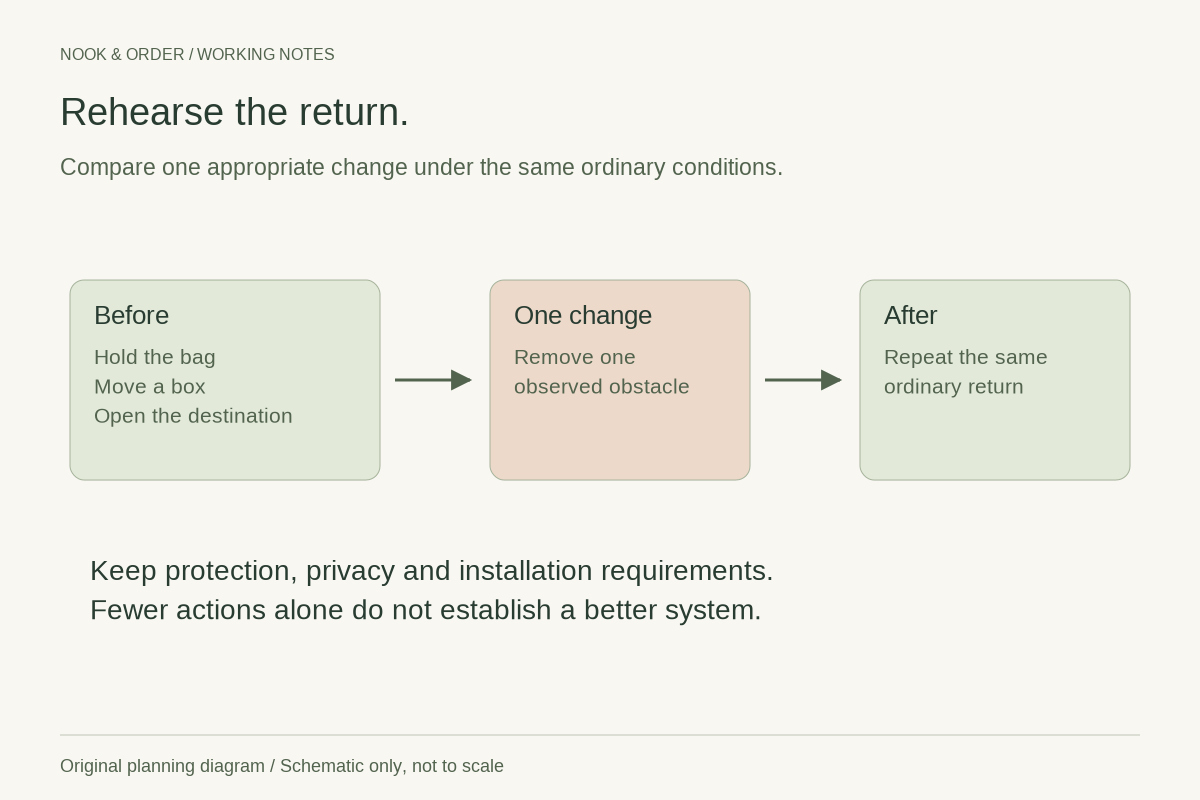
Rehearse the usual return with the normal neighboring contents present. Note actions such as moving a box, setting down another item, opening a lid, lifting a stack and making a second trip. Record the sequence in plain language. Avoid timing a person or converting the notes into a ranking of household members.
Some steps have a purpose. A cover may protect contents, a door may maintain privacy and a product may require a particular storage position. Mark those as constraints rather than automatic targets for removal. The question is which avoidable step creates the snag, and whether it can be changed while preserving the actual requirements. Fewer actions alone do not prove a better arrangement.
Select one reversible adjustment
Choose a change that addresses the observed obstacle: move a suitable container to an accessible location, reduce an unrelated stack or give a portable kit a clearer destination. Keep the rest of the system as similar as practical. If you change labels, container type and location together, it becomes harder to understand what helped.
New York State DEC describes reuse and repair as ways to keep useful objects in service. For this trial, an appropriate container you already own can help you test the arrangement before shopping. That is an editorial application of reuse, not a claim that every old box is suitable for every content. Check support, dimensions, condition and the needs of the belongings before using it.
Preserve protection and safe installation
Do not remove a required door, fixing or restraint simply to shorten the action. CPSC furniture guidance emphasizes securing furniture according to manufacturer instructions. A more convenient shelf still has to be suitable for the load and its installation. Avoid improvised modifications and do not introduce a new obstacle into a household route.
Keep privacy requirements visible too. Personal documents may need an enclosed or otherwise appropriate destination even if an open tray would be faster. Compare acceptable alternatives within the constraints. If there is no suitable easy change, the useful outcome can be a clear request for advice or a different category assignment. The trial need not end with a modified piece of furniture.
Repeat the same situation on ordinary occasions
Use the adjusted destination during the next relevant occasions. Three observations can be a manageable notebook format, but they are not a scientifically validated threshold. Record what happened, what remained awkward and whether a new problem appeared elsewhere. Include the approach to the destination as well as the final placement.
Do not judge the result only immediately after sorting, when contents are unusually sparse. Recheck with the usual neighboring items and returning load. If the object reaches its destination but the container now blocks another task, the change needs revision. Ask the actual user whether the arrangement is understandable and sustainable before treating a successful rehearsal as the permanent household rule.
A hypothetical bag and a two-handed lid
Imagine a bag intended for a lidded bench box. On arrival, the person is also carrying a shopping bag. They put the work bag on a chair because the lid needs both hands and the box is partly covered. A label on the box would name the destination without removing either physical obstacle.
A suitable trial might separate the work bag from the covered group and give it an appropriate accessible destination. Record whether the bag is returned there during ordinary arrivals and whether the change keeps the route clear. If the person still stops at the chair, ask which action remains difficult. This is a hypothetical diagnostic example; no measured time saving or universal behavioral effect is claimed.
Keep the observation with the arrangement
Write a short explanation of the useful change: which item it serves, the snag removed and what protection or boundary must remain. Keep it in a household note where relevant users can find it. This gives the next tidy-up a reason for the arrangement beyond matching a photograph.
If the trial fails, return to the observed journey rather than buying a more elaborate organizer by default. Capacity, an unresolved task or a disagreement about ownership may be the actual cause. Use the storage problem finder to keep several causes visible, then choose another small change only when you can explain which obstacle it addresses.
PUT THIS GUIDE TO WORK
Compare the same return action
Keep the item, user and ordinary situation comparable before and after one suitable change.
| Check | Record or try | If it does not work |
|---|---|---|
| Before | Write the approach, handling steps and required protections | Do not time or rank household members. |
| Change | Remove one observed obstacle reversibly | Keep protection, privacy and product instructions intact. |
| After | Observe the next relevant returns with usual neighbors present | Record a new problem elsewhere instead of ignoring it. |
Finish when: The item returns appropriately and the user understands why the arrangement helps.
Pause when: Convenience would remove required protection, permission or safe installation.