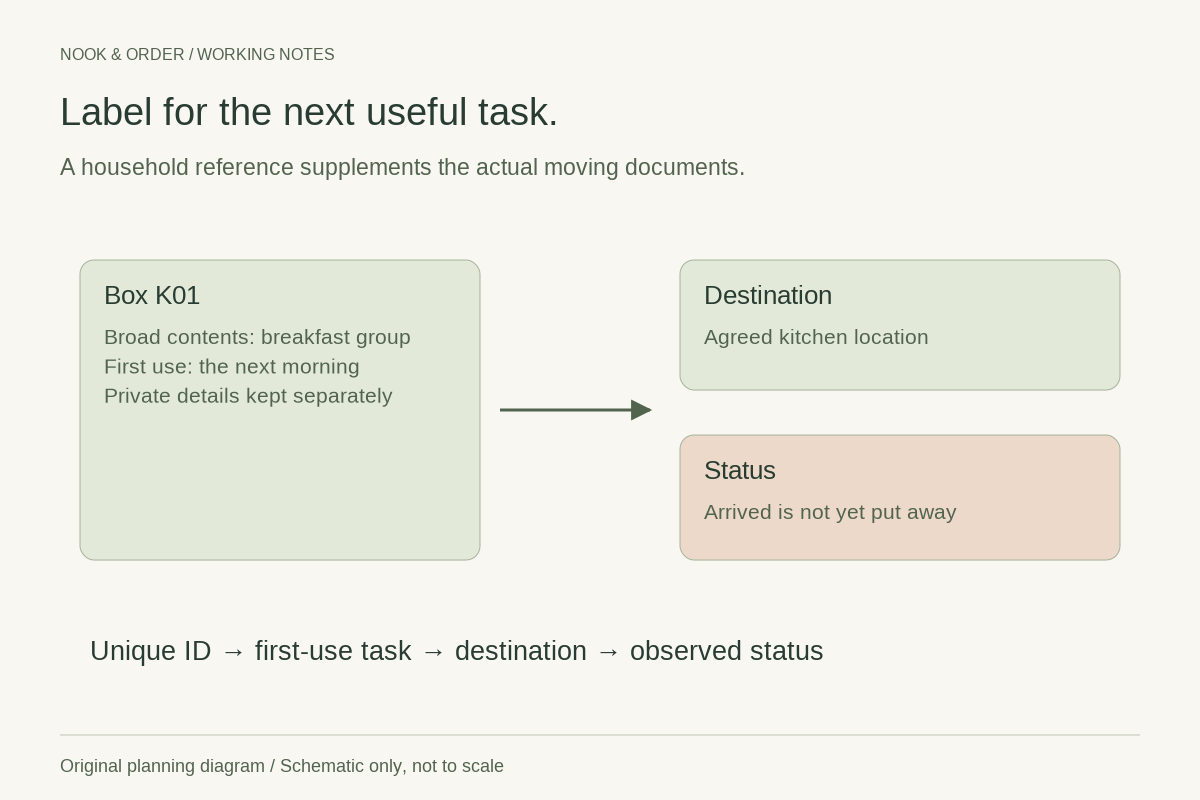
A moving inventory is more useful when it helps you find the first thing you need after arrival. A list of boxes labeled miscellaneous may count the shipment without explaining where anything belongs. This guide builds a household reference connecting each group to its destination and unpacking priority. It is separate from a property's condition record, a mover's official inventory and any insurance or contractual documentation. Keep those documents alongside it where relevant, rather than assuming one replaces another.
Create a small set of identifiers
Give each box or suitable moving group a unique short identifier, such as K01 for a kitchen group. Write the same identifier on the household list and the external label. Use a destination name understood by the people moving and receiving the belongings. If a new room has no familiar name, agree one before labeling several boxes differently for the same place.
Keep the external label proportionate. The destination and identifier may be enough for ordinary handling; detailed private contents can stay in a separate appropriate record. Do not put identity documents, account information or access codes on publicly visible labels. The inventory should help locate belongings without unnecessarily advertising sensitive contents to everyone passing the box.
Record the first useful unpacking task
Alongside the broad contents, write what the group enables: prepare breakfast, make the bed or resume the agreed work setup. This explains why one box matters earlier than another without declaring every possession essential. Separate what you will personally need during the move from goods handled through the shipment, following the actual arrangements and relevant requirements.
Do not bury required instructions among anonymous papers. Connect the product model, care information or approved assembly instructions to the relevant item record. A photograph can help identify a group, but it should not become the only index. Use clear filenames linked to the identifier so a folder of images remains searchable after the move.
Keep condition records and shipment records distinct
The FMCSA's moving guidance explains written documents and inventories in the context of United States interstate moves. Its scope is important: it does not determine the obligations of a mover in every country or type of move. Read the actual provider's documents and relevant local guidance. A personal worksheet should not be presented as an official shipment inventory or a legal claim form.
Where a mover records condition or identifiers, preserve the connection to your household record without overwriting their wording. Keep copies of the documents you are given. Discuss discrepancies through the appropriate process. Record a reported concern separately from the fact that you took a photograph, because documentation alone does not confirm that another party has received or accepted it.
Plan large objects as their own groups
Give furniture and other large objects their own entries. Record exact product identity, destination and the appropriate handling or assembly instructions. Do not assume a piece can be dismantled because that would make the route easier. Keep any supplier or installer advice with the entry and arrange suitable help for the actual object.
The Canadian Conservation Institute's wood-care guidance notes the importance of checking condition and loose joints before moving furniture. For the household inventory, this supports identifying an assessment or handling question before the move. It is not permission to attempt specialist handling from a short checklist. Fragile, unstable or valuable objects may need suitable professional advice rather than an improvised packing method.
Track a few meaningful statuses
Use statuses that correspond to observed events: planned, packed, arrived and unpacked into the intended destination. Add an issue note when needed. Avoid marking unpacked merely because a box was opened; its contents may still be on the floor without a usable home. Likewise, a packed status does not prove the shipment was collected or delivered.
Keep the status list simple enough to maintain during a busy move. If several people update it, agree who records arrival and how a discrepancy is flagged. Make a backup of the relevant household reference using your chosen appropriate method. Avoid sharing an unrestricted inventory containing private material when a smaller list of identifiers and destination rooms would serve the same coordination task.
A hypothetical first evening with three similar boxes
Suppose K01 holds the breakfast group, K02 occasional serving pieces and K03 items awaiting a separate decision. All three arrive in the kitchen. If the labels only say kitchen, someone may open every box to find the breakfast group. The household record instead links K01 to the first morning's task and the planned destination.
When K01 is opened, its status remains arrived until the relevant contents have appropriate usable places. K03 stays on a separate decision list rather than quietly filling the first empty cupboard. This hypothetical example does not prescribe which kitchen items a household needs. It demonstrates how unpacking priority can describe an activity instead of a box's attractiveness or its position in the delivery pile.
Finish with a location, not an empty carton
After unpacking a group, record where its useful contents now belong and any care or installation question still unresolved. Keep personal property and rental condition records separate from this household inventory. If a box or item is missing or damaged, use the actual provider's applicable reporting process and preserve relevant documentation; this guide does not establish deadlines or eligibility for compensation.
The inventory is complete when it helps answer both where something arrived and where it can now be found. Retain only the level of detail you still need, and handle copies containing private information appropriately. A shorter accurate reference is usually more useful than a detailed list whose statuses stopped being updated halfway through the move.
PUT THIS GUIDE TO WORK
Connect a box to its first useful task
This household list supplements the actual mover and property records; it does not replace them.
| Check | Record or try | If it does not work |
|---|---|---|
| Identity | Unique group ID and agreed destination name | Keep private contents out of public labels. |
| Use | Broad contents, first-use task and instruction reference | Separate a shipment record from a property condition record. |
| Status | Planned, packed, arrived, then actually put away | Keep missing items and unresolved issues explicit. |
Finish when: Each unpacked group has an appropriate findable destination and unresolved issues remain recorded.
Pause when: The move needs specialist handling or interpretation of provider terms and reporting requirements.