A difficult week needs a smaller plan with a clear ending. Simply cutting every task in half can leave laundry unfinished, care equipment out or important decisions hidden in a pile. This guide helps you choose a few complete household outcomes within the time and facilities actually available. It does not define a universal minimum standard of cleanliness or replace product instructions, urgent safety action or advice for individual health needs.
Start with what has changed this week
Record the practical constraint: fewer evenings at home, a visitor, a changed work pattern or less capacity for physical tasks. You do not need to justify the constraint by comparing yourself with another household. Write the active time you can realistically offer and any period when a shared space or appliance is unavailable.
Keep urgent safety concerns and tasks with specific requirements outside an optional tidying list. A leaking fitting, unsafe equipment or a material needing specialist advice cannot be resolved by assigning it ten convenient minutes. Identify the appropriate response and responsible person. For ordinary tasks, use the changed circumstances to set the scope of the week before copying an old routine into a new calendar.
Describe outcomes rather than rooms
Replace “do the bedroom” with a result that can be recognized: a complete linen change put away, tomorrow's essentials returned or one paper action completed. This separates a useful finish from an open-ended room project. Include putting away the materials used for the task in the outcome, so the plan does not end at the moment the room looks temporarily better.
Ask which outcomes would make the next ordinary activity easier. A prepared work kit may matter more this week than reorganizing decorative objects. These are household choices, not a ranking of every person's priorities. Discuss shared needs and leave personal belongings under their owner's control. Record a smaller result only when it still makes sense as a complete task.
Separate active work from elapsed time
Write down preparation, active work, waiting or drying and return. The weekly planner schedules estimated active minutes only. It does not know when a washing machine is available, whether a textile is dry or whether an owner can act at a proposed time. Keep those dependencies in your task description or separate household notes.
Canadian Conservation Institute guidance for textiles identifies clean, dry condition as important before suitable storage. Its advice concerns object care and does not supply a timetable for every household textile. Follow the exact item's instructions and actual condition. A short active-time estimate must not become a reason to close storage before care is complete. If the whole process cannot be accommodated, choose a different complete outcome.
Define a reduced version before beginning
For a large ordinary reset, describe a smaller useful version in advance. Instead of reviewing every document, deal with one time-sensitive paper and leave the rest in an identified review destination. Instead of reorganizing the whole wardrobe, return the ready active group and record a separate sorting task. Keep the reduced version truthful about what remains.
Avoid renaming partial treatment as completion. Dust removal and stain treatment are different tasks, and the Canadian Conservation Institute's wood-care guidance distinguishes care decisions according to surface and condition. A quick pass is not permission to use an unverified product. Choose a permitted, limited task or pause for clarification. Reduced scope should remove optional work, not omit a required stage of the selected care method.
Place commitments before optional improvements
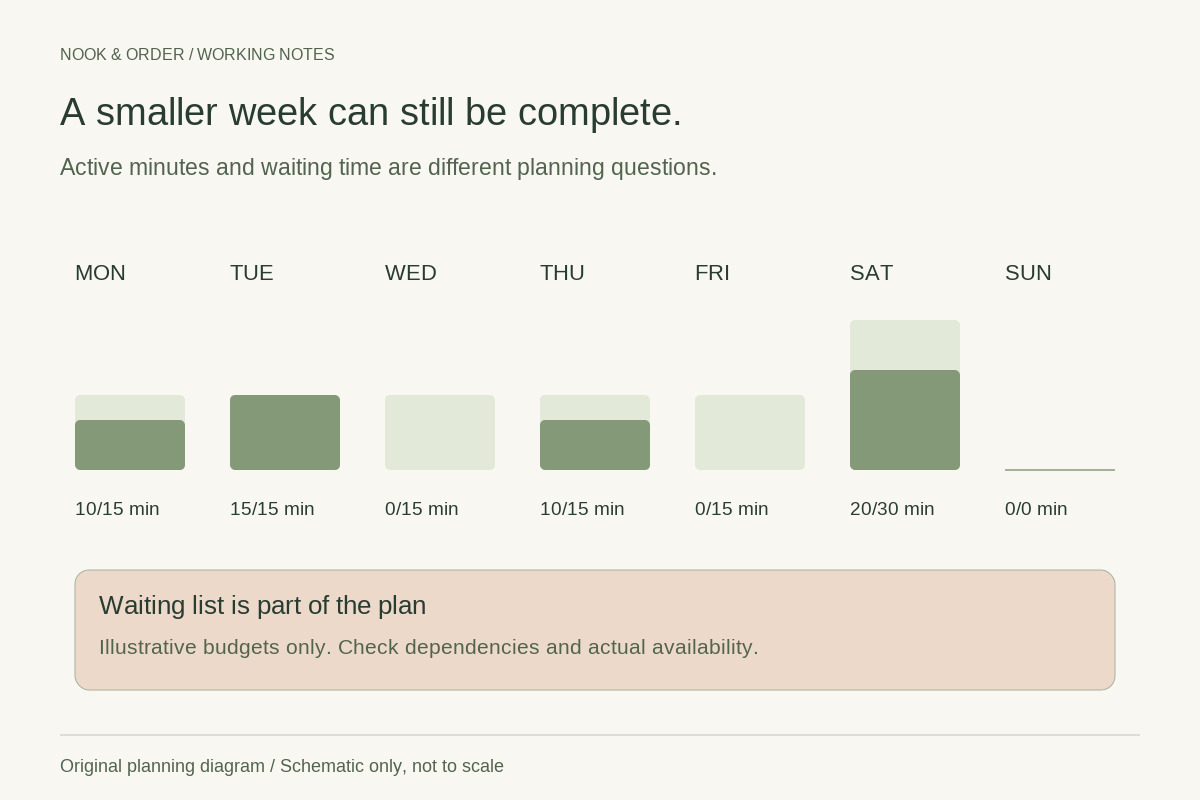
Enter agreed tasks with your own estimates and relevant day constraints. Give fixed-day tasks their required day when that reflects the real arrangement. Then use flexible space for the remaining complete tasks. The planner places fixed-day tasks first and flexible tasks on the least-used day that has sufficient remaining time. This is a transparent suggestion, not an optimized household schedule.
Read the waiting list as part of the result. A task that cannot fit has not disappeared or failed a character test; it needs a different budget, smaller complete scope or another agreed time. Do not increase every daily budget merely to make the list look finished. Check what changed and discuss the tradeoff with the people who share the work.
A hypothetical week with a blocked drying stage
Imagine a household has time to load a machine but no suitable drying capacity for an additional textile load. The ordinary weekly plan includes washing and returning that group. Counting the loading minutes alone would make the task appear to fit, while leaving the process unable to reach its proper end.
A smaller complete plan might return the already ready laundry and postpone the additional load until the actual care sequence can be accommodated. The waiting task should name the missing drying opportunity. This hypothetical example is about a dependency, not a washing recommendation. The right action depends on the items, equipment and care instructions in that home. The planner cannot observe those conditions on the household's behalf.
Review one useful consequence
At the end of the relevant period, check whether the selected next activity became easier. Could the morning start with the prepared essentials? Was the paper action completed? Did the ready laundry reach its destination? Keep observations concrete and leave unfinished work identified. A deliberately smaller completed plan can provide a clearer starting point than an ambitious plan whose partial stages are scattered around the home.
Adjust the next week's estimates using what happened, while allowing that circumstances may change again. Keep the reduced version available rather than treating it as an emergency exception that must be invented each time. Save or download the planner note if useful, and remove sensitive details before sharing it with someone else.
PUT THIS GUIDE TO WORK
Choose the smaller complete outcome
Plan active minutes separately from waiting, drying, facilities and people’s actual availability.
| Check | Record or try | If it does not work |
|---|---|---|
| Outcome | A visible useful finish, including putting equipment away | Replace a room-sized project with one complete task. |
| Dependencies | Preparation, care stages, waiting and return | Do not skip a required care stage to fit a budget. |
| Waiting list | What cannot fit and the condition needed to resume | Keep the task visible without inflating every day’s budget. |
Finish when: The agreed smaller outcomes are complete and the remaining tasks have a named next condition.
Pause when: Urgent needs or product requirements are being treated as optional scheduling choices.