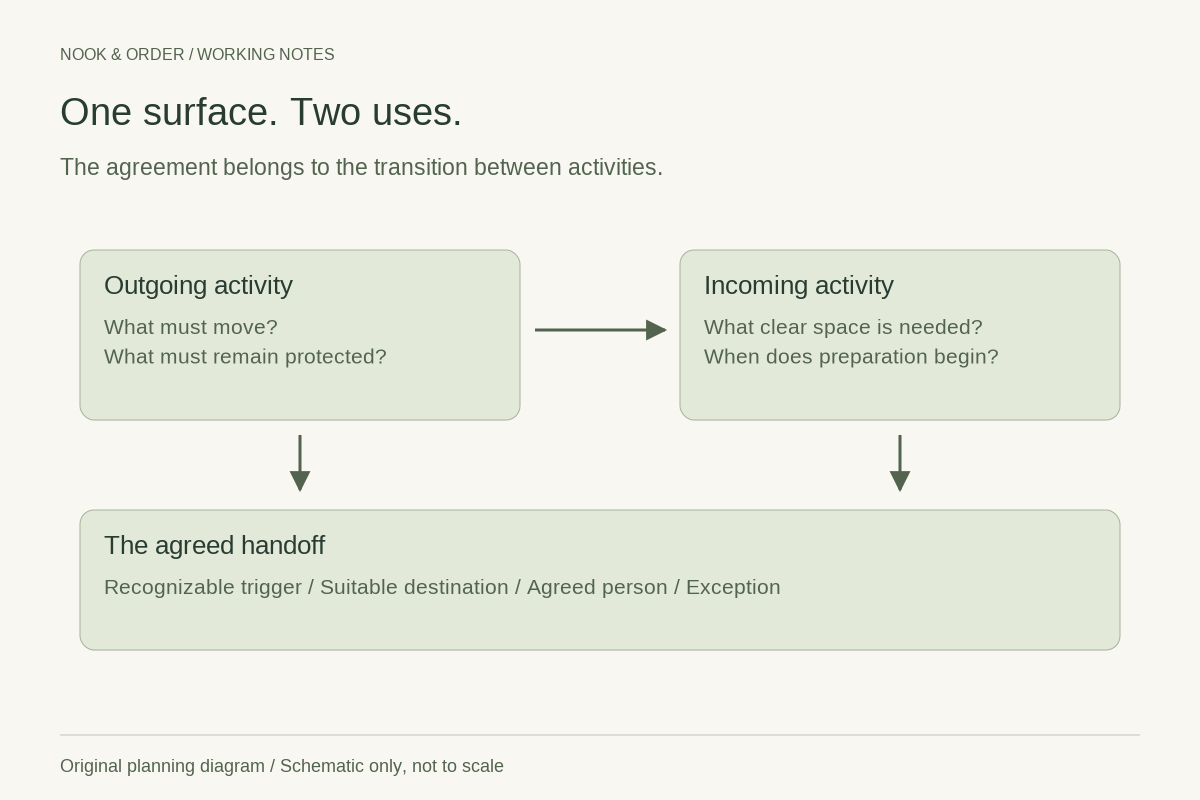
A dining table used for work can fail at the moment the next activity begins. The issue may not be the quantity of possessions but the absence of an agreed transition. This guide develops a handoff for one shared surface: what leaves, what may remain, where unfinished work goes and who has the next action. It is narrower than a whole-home organizing agreement and should be discussed by the people using the surface.
Name the two activities that collide
Choose the transition that causes repeated difficulty. Work to dinner, craft to homework or breakfast to remote work are different situations. Write what the incoming activity needs in practical terms: a clear place setting, access to the surface or space for particular equipment. Avoid describing the required result as simply tidy, because users may interpret that differently.
Ask the outgoing user what must remain connected, protected or ready to resume. Some work can move as a kit; other equipment may need a fixed appropriate location. Personal documents, tools and unfinished projects have different handling requirements. The handoff should acknowledge those differences before anyone is asked to sweep everything into a general basket.
Agree the event that starts the transition
Use an event both people can recognize, such as finishing the work session or beginning meal preparation. A precise clock time can help some households, but do not impose one that conflicts with actual schedules. Name who starts the transition and how they signal a genuine exception. A rule that depends on guessing another person's intentions creates a new source of uncertainty.
Include the incoming user's preparation time. If the table is needed before food reaches it, clearing it only at serving time may still fail. Discuss the handoff outside the busy moment when practical. This is an agreement about shared use, not authority for one person to inspect private papers or dispose of another person's unfinished work.
Build a destination for unfinished work
Select an appropriate temporary destination for the portable group. Record what belongs in it and where it rests between sessions. Keep confidential information and potentially harmful materials suitably protected. A named kit can be useful when it makes the entire session identifiable, but its container and location must suit the actual contents.
NYSDEC encourages reuse before acquiring more materials. An appropriate existing tray or container can be considered for a trial, with its support and dimensions checked first. The point is to rehearse the transition before buying a storage system. Do not describe a basket as a solution if the group still cannot be moved appropriately or if the basket's resting place blocks the next activity.
Divide the work explicitly
List the actions on both sides: pack the work kit, return unrelated items, prepare the next activity and reset afterward. Ask who agrees to each action. The person who needs the surface next should not silently inherit the whole clearing task, and the person who designed the arrangement should not automatically become its permanent manager.
Leave room for different capacities and schedules. Equal-looking task lists do not establish a fair arrangement for every household. Discuss what each person can actually sustain. If an action remains unassigned, keep it visible as unresolved rather than writing a name on someone else's behalf. The planning tool's owner field is a note of agreement, not a command or calendar reservation.
Rehearse a complete round trip
Try the outgoing transition, the incoming activity and the return to the original use. A kit that clears dinner successfully may still make tomorrow's work difficult if its contents lose their order. Observe both directions and note any task that has merely moved to the floor or another person's surface.
Keep the trial bounded. Use the next relevant transition or a few ordinary occasions, then discuss what happened. A polished photograph is not necessary. Useful observations include whether the incoming activity started, whether the outgoing work remained identifiable and whether the agreed actions happened without new confusion. If a physical obstacle remains, separate it from the question of who remembered the agreement.
A hypothetical table with an unfinished project
Suppose a table supports a sewing project and evening meals. The project includes materials that need suitable storage and should not be mixed with food preparation. The users agree a safe portable grouping and a specific resting place, with the project owner responsible for the outgoing transition. Meal preparation begins only when the table is appropriately available.
On the first trial, the fabric moves but the accompanying notes are left behind. The useful revision is to include the notes in the project record, not to label the person untidy. If a tool cannot be moved or stored appropriately, the handoff needs another location or arrangement. This hypothetical example demonstrates a missed stage; it does not prescribe a storage method for all craft equipment.
Keep an exception and a review point
Agree what happens when the ordinary handoff cannot be completed. An exception might involve discussing another suitable surface or changing the timing together. It should not authorize unsafe storage or unilateral removal of another person's belongings. Keep the exception short enough to remember and specific enough to avoid recreating the original disagreement.
Record the activity pair, trigger, destination, agreed people and next review event in a few lines. After the trial, keep the useful steps and remove obsolete ones. If the surface still fails, identify whether the remaining problem is space, handling, scheduling or agreement. That distinction gives the next conversation something concrete to change.
PUT THIS GUIDE TO WORK
Write a surface handoff agreement
Discuss this worksheet with the people using the surface; do not assign work for someone without agreement.
| Check | Record or try | If it does not work |
|---|---|---|
| Activity pair | Outgoing task and what the incoming activity needs | Replace “tidy” with a visible finish condition. |
| Transition | Recognizable trigger, portable group and suitable destination | Rehearse the next use and the return tomorrow. |
| Agreement | Who acts, what happens on an exception and when to review | Keep an unassigned action visibly unresolved. |
Finish when: Both activities can begin and unfinished work remains identifiable and appropriately protected.
Pause when: The arrangement depends on violating personal boundaries or unsuitable storage.