An unlabeled table or textile creates an information problem before it creates a cleaning task. Choosing a product from color, texture or a familiar social-media recipe can hide that uncertainty rather than resolve it. This guide helps you collect the details needed to identify the object, compare instructions and ask an appropriate maker or specialist a useful question. It offers no household chemical test, restoration procedure or promise that an unknown mark can be removed.
Identify the object before naming the material
Look for a maker, model, product tag, receipt or existing instruction record without dismantling or damaging the object. Photograph accessible identifying details in ordinary light. Record which component the label belongs to: a removable cushion, its filling and the complete sofa may have different instructions. Keep an uncertain recollection visibly marked as background information rather than confirmed identification.
Write what you actually know. “Dark table, model unknown, glossy surface” is more honest than calling it an oiled hardwood table without evidence. A seller's description may help locate information, but it does not establish the object's current finish after possible treatment or refinishing. Preserve the distinction so later advice is not based on an assumption introduced during your own note-taking.
Record condition without experimenting
Describe the concern in neutral terms: a pale ring, loose coating, sticky area or missing label. Note when it was noticed and what happened beforehand if known. Record any product already used, including the exact name when available. Avoid adding another treatment simply to obtain a more impressive before-and-after photograph.
The Canadian Conservation Institute's wood guidance describes material and finish vulnerabilities that make general treatment assumptions unreliable. Its textile guidance likewise addresses condition, support and appropriate care. These sources concern object preservation; they do not identify your possession through a photograph. Use them as reasons to preserve uncertainty and obtain suitable advice, rather than borrowing a museum procedure for every ordinary household item.
Separate prevention from treatment
While seeking information, consider whether an avoidable source of exposure can be addressed appropriately: a leaking plant container, a nearby wet object or unsuitable handling around the item. This does not mean moving a fragile object yourself or covering a problem with a product that might create another one. Choose only actions compatible with what is known and seek help where handling is uncertain.
Keep prevention distinct from cleaning. Removing a source of moisture does not prove an old mark is safe to treat. A dusting method that is appropriate for an intact known finish does not automatically apply to a surface that is flaking or catching the cloth. If a surface changes unexpectedly during any permitted routine, stop and preserve the relevant details for advice.
Compare instructions at the right level
If you find several instructions, list what each one actually covers. The maker's sheet may refer to the original product, a fabric label to one component and a cleaner bottle to certain compatible surfaces. A broad article about wood or cotton may not address the finished object at all. Do not average conflicting instructions into a new recipe.
Check whether the information matches the exact variant and current condition. Refinishing, repair, mixed materials or a missing component can change the question. Record the conflict in a sentence, such as “The cover has a zip, but the finished item's washing permission is not established.” That gives the adviser a specific issue to clarify rather than asking for approval of a method chosen in advance.
Send a compact identification request
Prepare the product details, component, condition description, relevant photographs and the precise question. State what you have already tried. Use the maker's appropriate support channel or seek a suitably qualified specialist when the object is fragile, valuable, historic or outside ordinary care. Keep personal details and unrelated household photographs out of the request where possible.
Ask what they can identify, which guidance applies and what further information they need. A useful answer may be that remote identification is insufficient. Preserve that limitation instead of translating it into informal permission to try a cleaner. Keep the reply with the object record so the same uncertainty does not return each time another household member prepares to clean it.
A hypothetical unlabeled chair cover
Imagine a chair with a removable-looking cover, a fiber description from a previous owner and no finished-item care instruction. The zip indicates access to the cover, but the record does not yet establish a permitted washing and drying sequence. A bottle described as suitable for fabric adds another product claim without identifying the chair's actual requirements.
The next task is to locate the model or obtain appropriate advice about the complete cover and its components. The household can record the question and any current condition concern while leaving treatment unresolved. This hypothetical example does not state that all removable covers must remain unwashed. It shows why one visible feature cannot supply missing care permission for an unidentified finished item.
Close the question only to the extent answered
When advice arrives, record the date, who supplied it, the identified object and the scope of the answer. If it establishes routine loose-dirt care but leaves stain treatment unresolved, keep those as separate entries. Do not generalize permission from one table or textile to another because they look similar.
Use the home-care instruction file guide to keep the resulting record findable. The useful outcome may be a permitted method, a specialist assessment or a clear decision to leave treatment unattempted. In each case, the original uncertainty is represented honestly, rather than hidden behind an attractive cleaning checklist or an unverified claim that a household mixture is gentle.
PUT THIS GUIDE TO WORK
Prepare a care identification request
Collect facts without scratching, applying solvent or otherwise testing the unknown material.
| Check | Record or try | If it does not work |
|---|---|---|
| Identity | Maker, model, exact component and any label | Mark recollections and guessed materials as uncertain. |
| Condition | What changed, when noticed and products already applied | Do not add experiments while waiting for advice. |
| Question | Which guidance applies, what is permitted and what remains unknown | Keep the answer’s scope attached to this object. |
Finish when: The record identifies a permitted next step or an explicit unresolved question for suitable advice.
Pause when: The item is fragile, valuable, unstable or its surface reacts unexpectedly.
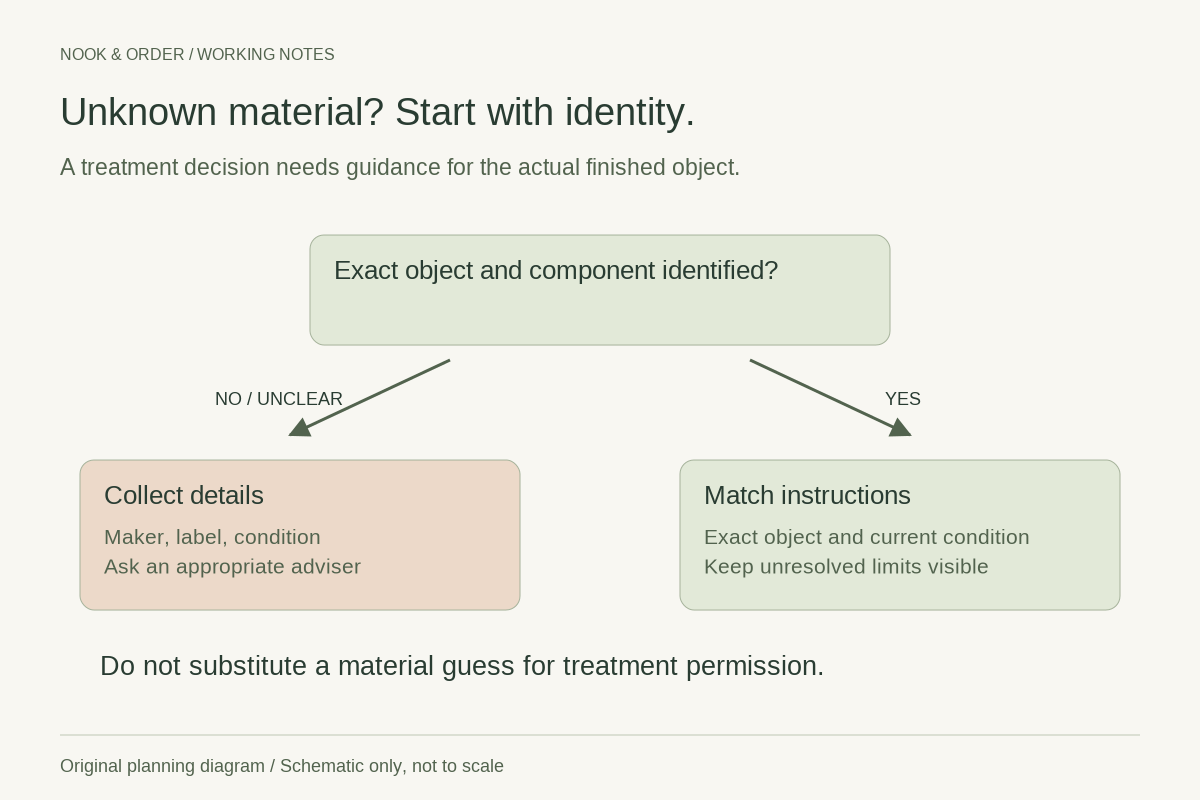
An unknown-care decision path
- Can the exact object and component be identified? If no, collect non-invasive identifying details.
- Does current guidance match its condition? If no, describe the conflict.
- Is the proposed method explicitly applicable? If no, obtain clarification.
- Does the answer leave limits? Keep those limits with the item record.
A photograph, material guess or hidden-area trial cannot guarantee long-term compatibility.